Which mushroom should you grow first? Canadian guide
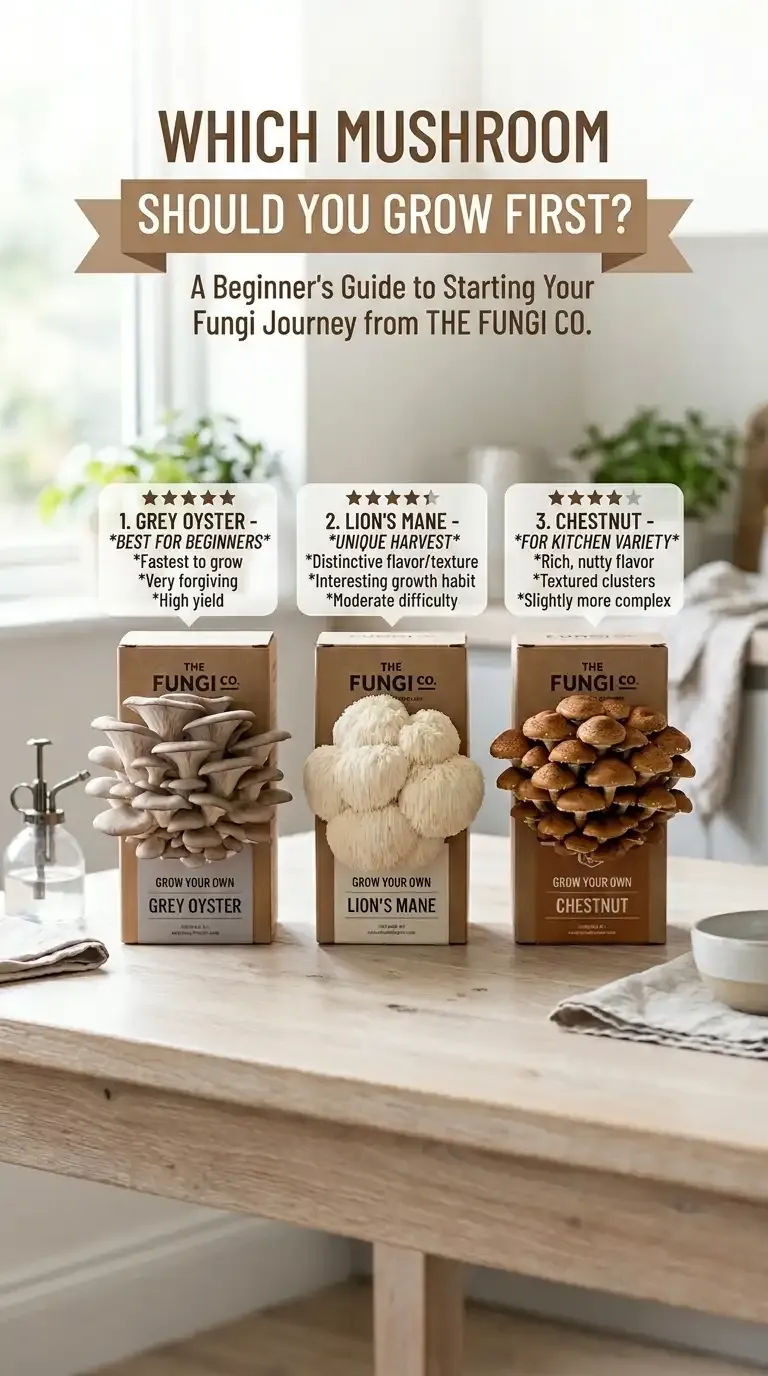
There are a dozen reasonable first species to grow at home. The wrong question is “what’s the best mushroom?” — the right question is “what’s the best mushroom for me, given what I have, where I live, and what I want to cook?”
This is a decision walk-through, not a ranking. Answer four questions and you’ll know what to grow.
TL;DR — the decision tree
| Question | Answer | Pick |
|---|---|---|
| Do you have a pressure cooker? | No | Grey or blue oyster (straw method) |
| Do you have a pressure cooker? | Yes | Continue ↓ |
| Will you check your grow daily? | No | Grey, blue, or white oyster (more forgiving) |
| Will you check your grow daily? | Yes | Continue ↓ |
| Is your fruiting space < 18 °C? | Yes | Blue oyster, lion’s mane, or shiitake |
| Is your fruiting space < 18 °C? | No | Pink/yellow oyster, king oyster, or chestnut |
| What’s the goal? | Maximum yield | Grey oyster on Masters Mix |
| What’s the goal? | ”Vegan meat” / scallops | King oyster |
| What’s the goal? | Visual wow / gift | Pink oyster (colour) or lion’s mane (shape) |
| What’s the goal? | Year-round outdoor patch | Shiitake on logs |
The four questions, in detail
Question 1: Do you have a pressure cooker that hits 15 PSI?
If no: you’re growing on pasteurized straw, period. Hot-water pasteurization in a tub or stockpot is enough for oyster mushrooms, which dominate on straw. Lion’s mane and shiitake on supplemented sawdust require pressure sterilization — without it, your contamination rate will be 50%+.
No pressure cooker → grow grey or blue oyster (bucket method). See how to grow oyster mushrooms in Canada.
If yes: you have access to every cultivated species. Continue.
(See our best pressure cooker for mushroom growing in Canada guide if you don’t have one yet.)
Question 2: How often will you check your grow?
Mushroom species differ wildly in how forgiving they are about harvest timing:
- Pink oyster: check twice daily during fruiting. From perfect to past-prime is sometimes 12 hours.
- Yellow oyster: same as pink.
- Grey, blue, white oyster: check once a day during fruiting. You have a 24-48 hour grace window.
- King oyster: check once a day. Forgiving 48-hour window.
- Lion’s mane: check once a day. Forgiving window but FAE matters more than timing.
- Shiitake: check every 2-3 days. The slowest, most forgiving species.
If you travel a lot or have unpredictable schedules: don’t pick pink or yellow oyster. Pick grey/blue oyster, king oyster, or shiitake.
Question 3: What’s the temperature of your fruiting space?
Most Canadian indoor environments fall into one of three categories:
Cool space (10–18 °C)
Common in:
- Unheated basements (winter)
- Cool garages (spring/fall)
- North-facing rooms in older houses
- Anywhere in winter outside the main heated zone
Best fits:
- Blue oyster — designed for these temperatures
- Lion’s mane — fruits cleanly at 15–18 °C
- Shiitake — fruits at 10–18 °C
- King oyster — works but slower
Skip: pink and yellow oyster (need 18+ °C to fruit)
Moderate space (18–22 °C)
Common in:
- Most heated Canadian homes year-round
- Heated garages
- Spare bedrooms with the door closed
Best fits: any cultivated species. This is the universal sweet spot.
Warm space (22+ °C)
Common in:
- Summer in any non-air-conditioned space
- Apartments with central heat in winter
- South-facing rooms
Best fits:
- Pink oyster — built for warm rooms
- Yellow oyster — same
- Grey oyster — works but lower yield
- King oyster — works but caps form smaller
Skip: blue oyster, shiitake (both stall above 22 °C)
Question 4: What do you want to cook with it?
This is the most-overlooked question. Different mushrooms are different ingredients.
”I want to make vegan meat substitutes”
→ King oyster. The stem-as-scallop texture is the closest a plant ingredient gets to actual seafood. Pulled-pork-style cooking also works (king oyster strands pull apart like roast pork).
See king oyster vs oyster vs lion’s mane.
”I want to make ‘bacon’”
→ Pink oyster. Famously called the “bacon mushroom” because cooked crispy with the right technique, it develops a smoky, savoury, chewy texture that scratches the bacon itch.
See how to cook pink oyster mushrooms.
”I want crab cakes / a seafood substitute”
→ Lion’s mane. The flavour and texture both read as crab. No other cultivated species does this.
”I want to use them in stir-fries and Asian cooking”
→ Shiitake (or king oyster if you want texture, or white oyster if you want neutral background).
”I want jerky / dehydrated snacks”
→ King oyster. No other species makes proper jerky texture.
”I want to make pickles / preserves”
→ Chestnut mushrooms. They hold their crunch through pickling better than any other cultivated species.
”I want to impress people with the photos”
→ Pink oyster (the colour is shocking) or lion’s mane (the shape is otherworldly). Both look amazing on a kitchen counter.
”I want maximum yield from minimum effort”
→ Grey oyster on Masters Mix. The workhorse — highest biological efficiency, fewest fussy variables.
”I want a patch I can ignore for years”
→ Shiitake on logs. Inoculate once, harvest for 4–5 years. See outdoor log inoculation.
The decision matrix
Putting it all together:
| Goal | If you have… | Pick |
|---|---|---|
| Easy first grow, any climate | No pressure cooker, mild temps | Grey oyster (bucket) |
| Easy first grow, cool basement | No pressure cooker, < 18 °C | Blue oyster (bucket) |
| Easy first grow, hot apartment | No pressure cooker, > 22 °C | Pink oyster (bucket) — but read the pink oyster guide on harvest timing |
| Maximum yield | Pressure cooker, 18–22 °C | Grey oyster (Masters Mix bag) |
| “Vegan scallop” cooking | Pressure cooker, any temp | King oyster |
| Seafood-like flavour | Pressure cooker, cool temp | Lion’s mane |
| Iconic deep umami | Pressure cooker, cool temp, patience | Shiitake (bag method) |
| Crunchy stir-fries / pickles | Pressure cooker, any temp | Chestnut |
| Year-round outdoor patch | Outdoor space + hardwood logs | Shiitake (log method) |
| Quickest harvest | Heated apartment | Pink oyster (4–6 days from pin) |
Budget reality check
What you’ll actually spend for each path’s first grow:
| Path | One-time | Per-cycle | First-harvest time |
|---|---|---|---|
| Bucket oyster | $0–10 (you have a bucket) | $30–40 | 4–6 weeks |
| Bagged oyster (Masters Mix) | $200 pressure cooker | $40–50 | 3–4 weeks |
| Lion’s mane (bagged) | $200 pressure cooker | $40–50 | 4–6 weeks |
| Shiitake (bagged) | $200 pressure cooker | $40–50 | 12–14 weeks |
| Shiitake (logs) | $60 drill + wax + plugs | $0 (logs are free) | 12–18 months |
The honest first-grow recommendation for most Canadians: grey oyster, bucket method, $35 total. Get one successful harvest cycle under your belt before you spend $200 on a pressure cooker.
Don’t pick more than one species for your first grow
A real beginner trap. You see all the options and think “I’ll do pink, blue, and king oyster — variety!” Each species has slightly different timing, environment preferences, and contamination rules. Managing three at once means tripling your variables.
One species, one grow, learn the rhythm. Then expand.
Spore safety reminder
Whatever species you pick, wear an N95 mask when handling spawn, opening colonized blocks, and harvesting. Every cultivated species sporulates; repeated unmasked exposure can cause hypersensitivity pneumonitis (“mushroom worker’s lung”).
Once you’ve picked a species, the relevant grow guide: How to grow oyster mushrooms in Canada, How to grow lion’s mane mushrooms in Canada, How to grow shiitake mushrooms in Canada, Chestnut mushrooms, Outdoor log inoculation.
And our calculators for sizing the math: substrate, fruiting chamber, yield.