How to grow lion's mane mushrooms in Canada
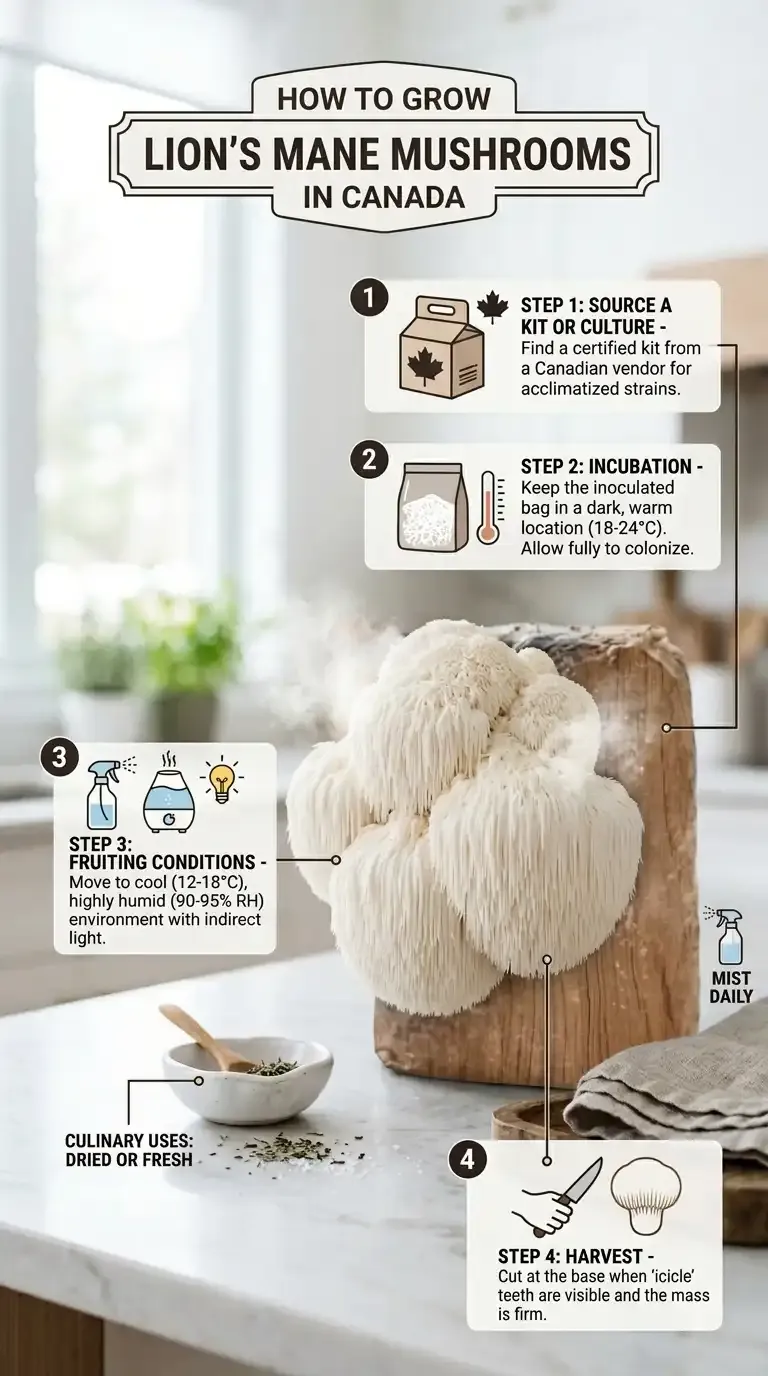
Lion’s mane (Hericium erinaceus) is one of the most rewarding home grows in Canada — the white, cascading “icicle” fruiting bodies look nothing like any other mushroom, the texture cooks like crab, and the species is reliable enough for first-time growers if you get one detail right.
That detail is fresh-air-exchange (FAE). Lion’s mane is dramatically more CO₂-sensitive than oyster or king oyster. Get the FAE wrong and you don’t get pretty round mushrooms — you get strange, branching, antler-like growths that look interesting but cook unevenly.
This guide is Canada-first and CO₂-focused.
TL;DR
- Substrate: supplemented hardwood sawdust (best) or Masters Mix
- Spawn source: order from a Canadian supplier; expect 1–2 weeks delivery
- Pasteurization vs. sterilization: sterilize — lion’s mane on supplemented substrate must be pressure cooked
- Colonization: 14–21 days at 21–24 °C
- Fruiting: 15–22 °C, high FAE (6–8 air changes per hour), 85–95% humidity
- First harvest: 4–6 weeks after inoculation
- Yield: 1.0–1.5 lb (450–700 g) fresh per 5 lb (2.3 kg) block, across two flushes
- Where it fails: under-ventilated chambers — get the fruiting chamber calculator right
Why lion’s mane specifically
The case for growing your own:
- Almost impossible to buy fresh in Canada outside of farmers’ markets and specialty grocers
- Dramatic visual — first harvest is a real wow moment
- Cooks like crab — the most distinctive flavour of any cultivated mushroom (see king oyster vs oyster vs lion’s mane)
- Forgiving on most variables — temperature, humidity, light — but fussy on CO₂
The case against:
- Slightly slower than oyster (4–6 weeks vs 3–4)
- Requires pressure sterilization (so a real pressure cooker, not an Instant Pot Duo on “high pressure”)
- Yields lower than oyster on the same substrate mass
- CO₂ sensitivity means you can’t half-ass the fruiting chamber
If you’ve already done one or two oyster grows and want a more ambitious second species, lion’s mane is the right next step.
Substrate: supplemented hardwood sawdust is the answer
Lion’s mane is a wood-rotting fungus that loves nitrogen supplementation. The standard recipe:
- 80% hardwood sawdust (oak, maple, beech — anything dense)
- 18% wheat bran
- 2% gypsum (calcium sulfate)
- Hydrated to 60% moisture (field capacity — wrings out 1–2 drops when squeezed)
Available from:
- North Spore (US, ships to Canada) — sells pre-made blocks if you don’t want to mix your own
- Sporeworx (Toronto) — sells the dry mix
- MycoSupply (BC) — sells supplemented sawdust by weight
- DIY — buy hardwood pellets from a feed store (yes — the cheap fuel pellets), wheat bran from a feed/health-food store, gypsum from a garden centre
Use our substrate calculator for sizing.
Why not straw?
Lion’s mane technically fruits on pasteurized straw — but the yield is poor (about 30–50% of what you’d get on supplemented sawdust) and the cluster shapes are smaller and stringier. If you only have straw, grow oyster.
Why not Masters Mix?
Masters Mix (hardwood pellets + soy hulls 50/50) works for lion’s mane and yields nearly as well as supplemented sawdust. Use it if you already have it on hand. Slightly faster to mix and equally effective.
Sterilization, not pasteurization
This is the most important difference from oyster cultivation.
Lion’s mane on supplemented sawdust must be pressure sterilized:
- 15 PSI for 2.5 hours in a pressure cooker (real pressure cooker — All American, Presto 23-quart, Pressure Pro, etc.)
- Bags or jars left to cool completely (8–12 hours) before opening
The high nitrogen content of the supplementation makes the substrate contamination-prone if you only pasteurize. Trichoderma (green mold) loves nitrogen-rich substrate. You will fail without pressure sterilization.
If you don’t have a pressure cooker yet: the Presto 23-quart at ~$200 CAD on Amazon.ca handles 4–6 bags per cycle and is the standard entry-level option. The All American 921 ($500+) is the upgrade you buy once you’re sure you’re sticking with it.
Spawn
Lion’s mane spawn options:
- Grain spawn (millet, wheat berries, rye) in a filter-patch bag — most common
- Sawdust spawn — slower colonizing but more contamination-resistant
- Plug spawn — only for outdoor log cultivation, not bags
For first-time indoor grow: grain spawn, 5–10% of substrate weight.
Canadian suppliers (same as the oyster guide):
- Sporeworx (Toronto)
- MycoSupply (BC)
- Forest Garden Mushrooms (Vancouver Island)
- North Spore (US, ships to Canada)
Setup: the bag method
For one 5 lb (2.3 kg) block:
- Inoculate in still air (in front of a still-air glove box or flow hood, or at minimum a draft-free room).
- Open the cooled, sterilized substrate bag.
- Add 150–230 g (5–10%) of grain spawn evenly through the substrate.
- Seal the bag with a heat sealer or fold-and-tape the top.
- Mix by shaking and squeezing the bag to distribute spawn uniformly.
For better contamination protection, work in a Still-Air Box (SAB) — a clear plastic tote with two arm holes cut in the side. Cheap to make, dramatically increases success rates.
Colonization
- Temperature: 21–24 °C (room temperature in most Canadian basements is fine)
- Light: dark (any room without direct sunlight works)
- Time: 14–21 days for a 5 lb block
You’ll see white mycelium spreading from each spawn site, eventually covering the entire substrate. The bag may discolour slightly (off-white to faintly yellow) — that’s normal for lion’s mane.
Watch for contamination:
- Green = Trichoderma — toss the bag, start over
- Black or pink = bacterial contamination — toss
- Faint yellow exudate (“mushroom sweat”) = normal for lion’s mane, not contamination
Fruiting (the CO₂ part)
This is where lion’s mane is different from every other oyster-family species.
The CO₂ problem
Lion’s mane fruits properly only when CO₂ stays below ~500 ppm. For comparison:
- Outdoor air: 400–420 ppm
- Closed bedroom: 1000–2000 ppm
- A poorly ventilated grow tent: 2000+ ppm
- Oyster will fruit fine up to 1000 ppm
- Lion’s mane goes weird above 600
When CO₂ is too high, instead of forming a tight cascading cluster of “icicle” spines (the photogenic, classic shape), lion’s mane elongates into branching antler-like growths. They’re still edible but the texture is uneven and the visual is wrong.
How to keep CO₂ low
For a typical home grow of 1–4 blocks, you need:
- A fruiting chamber sized 3× block volume (use our fruiting chamber calculator)
- 6–8 air changes per hour of fresh-air exchange
- A small inline duct fan on a timer: 15 minutes on / 45 minutes off, exhausting either outside or through a HEPA filter
- Or a shotgun fruiting chamber with frequent lid-opening — every 4–6 hours, fully open for 30 seconds
If you’ve been growing oyster with a low-FAE setup, expect to need to double your air exchange rate.
Environmental targets
- Temperature: 15–22 °C (lower end produces denser fruits)
- Humidity: 85–95% RH
- Light: 12 hours/day of indirect light (any 6500K LED bulb works)
- CO₂: <500 ppm if you can measure it
Cutting the bag
When the block is fully colonized:
- Cut two 5 cm (2 inch) X-shaped slits on opposite sides of the bag, about 5 cm from the top
- Each slit becomes a fruiting site
- Place the block in the fruiting chamber
- Mist the slits 1–2× daily with a spray bottle
Pins emerge from the slits within 5–10 days. Each cluster matures over the following 7–10 days.
Forcing fruiting
If pins haven’t appeared after 10 days at fruiting conditions:
- Drop the temperature 5 °C for 48 hours (e.g., move to a cooler spot or open a window during cool weather)
- Soak the block in cold water for 6 hours, then drain
Either trigger typically starts pinning within 5 days.
Harvest
Lion’s mane is ready when the spines (the “icicles”) are fully extended and just before they start turning yellow/brown at the tips. Once they start browning, you’re past prime — the texture gets dry and slightly bitter.
To harvest: cut the cluster at the base with a sharp knife. Avoid tearing — clean cuts heal better for the second flush.
Typical first-flush weight from a 5 lb block: 0.7–1.0 lb (320–450 g) fresh. Second flush, 10–14 days later, adds another 0.3–0.5 lb.
Yield expectations
Use our yield estimator for your setup. For lion’s mane on supplemented hardwood:
- First flush: 30–45% biological efficiency
- Second flush: 15–20% BE
- Total from a 5 lb block: 1.0–1.5 lb (450–700 g) fresh
Three blocks running in a single fruiting chamber produces about 3–4 lb of fresh lion’s mane every 6 weeks — enough for several meals plus dehydrated reserves.
Canadian regional notes
BC south coast
High humidity + mild winters = excellent year-round growing. Less need for active humidification.
Prairies
Dry winter air means you’ll need to humidify the fruiting chamber more aggressively. An ultrasonic humidifier on a humidistat helps.
Ontario / Quebec
The default Canadian growing climate. Basements at 18–22 °C work year-round.
Atlantic Canada
High ambient humidity is a help; just watch contamination pressure during damp summer stretches.
Far north
Achievable but slower. Use the warm end of the colonization range (24 °C) and consider supplementary heat on the fruiting chamber.
Cooking your harvest
See king oyster vs oyster vs lion’s mane for technique comparisons. Lion’s mane wants:
- Tear into chunks (don’t slice thin)
- High-heat pan with butter or oil
- 6–8 minutes until golden on both sides
- Salt at the end
- Pair with lemon, dill, Old Bay, garlic
Lion’s mane “crab cakes” are the most common application — see our upcoming lion’s mane crab cake recipe.
Storage
- Fridge, paper bag: 5–7 days
- Dehydrated and stored airtight: 6+ months
- Frozen (sautéed first): 3 months
Full storage details in how to store oyster mushrooms — lion’s mane follows the same rules.
Spore safety
Wear an N95 mask when:
- Opening colonized blocks
- Cutting fruiting sites into bags
- Harvesting
- Processing for storage
Lion’s mane is a lighter sporulator than oyster, but the cumulative exposure from repeated unmasked harvests can still cause hypersensitivity pneumonitis (“mushroom worker’s lung”). Get into the habit on your first grow.
Common failure modes
| Symptom | Cause | Fix |
|---|---|---|
| Antler-like branching instead of round clusters | CO₂ too high | More FAE, smaller chamber |
| No pins after 14 days | Not fully colonized OR temp wrong OR CO₂ too high | Wait longer; check temp; increase FAE |
| Cluster goes yellow/brown | Past prime — wait too long to harvest | Harvest 1–2 days earlier next time |
| Green mold on substrate | Contamination — bad sterilization or sterile work | Pressure cook longer; work in still air |
| Cluster dries out before maturing | Humidity too low | Mist more often; check chamber humidity |
| Very small first flush | Spawn ratio too low OR substrate not fully colonized | Use 8–10% spawn; wait longer next time |
Related: How to grow oyster mushrooms in Canada — the easier first species. Substrate calculator, fruiting chamber calculator, and yield estimator — all the math. King oyster vs oyster vs lion’s mane — cooking comparisons.
Safety & data: Mushroom worker’s lung: N95 spore-safety guide — the spore safety every grower needs. Common mushroom contamination — spot it and fix it. Mushroom growing conditions chart — temperature, humidity & timing for every species.