DIY fruiting chamber: shotgun + Martha tent builds
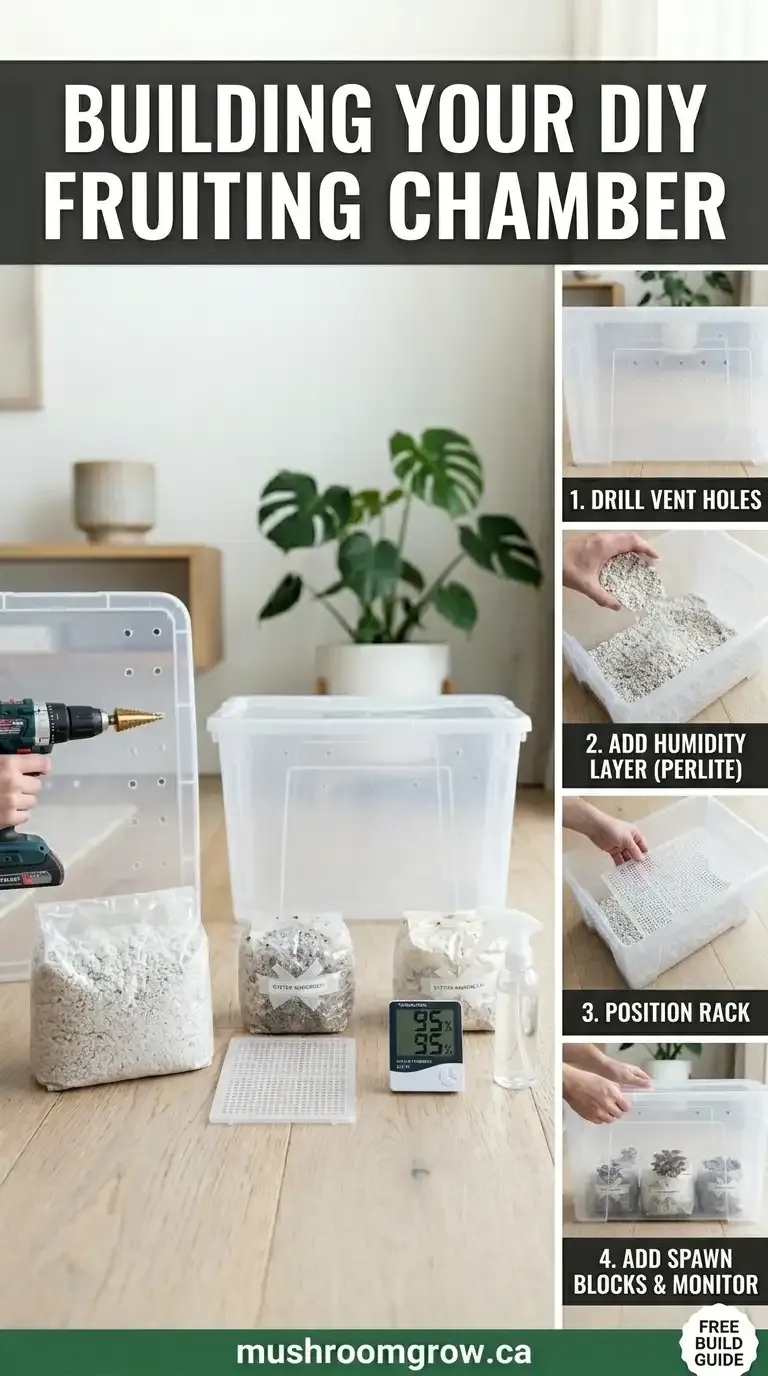
Most cultivation guides hand-wave the fruiting chamber and then act surprised when your first grow produces sad, stalled pins. The chamber is half the equation. Substrate determines whether your mushrooms grow; the chamber determines whether they finish well.
This post is two builds, both genuinely useful, with real materials and real timing.
Affiliate disclosure: Some links below are affiliate links — we may earn a small commission on qualifying purchases at no additional cost to you. See our full affiliate disclosure.
Which build for you?
| Shotgun chamber | Martha tent | |
|---|---|---|
| Build cost | ~$40 CAD | ~$200 CAD |
| Capacity | 1–4 grow bags or buckets (≤30 L of fruit block) | 4–15 grow bags or buckets (≤200 L) |
| Footprint | 60 × 40 × 40 cm — fits in a closet | 60 × 60 × 150 cm — fits in a corner |
| Effort to operate | Manual mist + fan 3× daily | Mostly automated |
| Best for | First-grow oyster on straw, single lion’s mane block, casual hobbyist | 2nd+ year hobbyist, multiple species at once, year-round production |
| Difficulty | Drill some holes | Source 6 parts and wire a humidistat |
Most Canadian growers start with the shotgun, then upgrade to the Martha tent when they realize they want to run 3+ blocks simultaneously.
Build #1: The shotgun fruiting chamber (SGFC)
The cheapest reliable fruiting chamber in cultivation. Designed for passive fresh-air exchange via 200+ small holes, with a humidity reservoir of wet perlite at the bottom.
Shopping list (~$40 CAD)
- Clear or translucent plastic tote, 60–110 L — Rubbermaid Roughneck (Canadian Tire, ~$20), IRIS USA, or Sterilite Show-Off. 80 L is the sweet spot — big enough for 2–4 grow bags, small enough to manage.
- Perlite, 2 bags (8 L each, total ~16 L) — garden centre or Canadian Tire (~$15). Look for “horticultural perlite,” not pool filter perlite.
- Spray bottle — dollar store, $2.
- N95 mask — pharmacy, $2 per mask.
Tools
- Drill with a sharp 1/4 inch (6 mm) bit
- Tape measure or ruler
- Permanent marker
- Bucket and sink (for soaking perlite)
Build it (1 hour)
-
Mark the drill pattern. On each side, the lid, and the bottom of the tote, mark a grid of dots spaced 5 cm (2 inches) apart in both directions. Yes, the bottom too. The bottom holes let air enter from below as it warms inside the chamber.
-
Drill every hole. A sharp 1/4” bit cuts through Rubbermaid plastic cleanly — push gently. You’ll end up with 200–400 holes total depending on tote size. This sounds like a lot. It is. Don’t skip holes.
-
Soak and drain the perlite. Pour the perlite into a bucket, cover with water, let sit 30 minutes. Then drain in a colander or directly through the bag’s bottom (the perlite holds onto plenty of water). Final consistency: wet to the touch, not dripping.
-
Fill the bottom. Pour the drained perlite into the bottom of the tote, 5–8 cm (2–3 inches) deep. This is your humidity reservoir.
-
Add a barrier. Lay foil, plastic mesh, or a wire cooling rack on top of the perlite. Your fruit blocks sit on this, not directly on the wet perlite (waterlogged substrate breeds bacteria).
Operating the SGFC
- Mist the inside walls of the tote 2–3 times a day with a spray bottle. Don’t spray the mushrooms directly — spray the chamber and let humidity equalize.
- Fan the lid for 30 seconds, 2–3 times daily. This swaps fresh air through the holes plus the lid-fanning. Passive FAE is enough for oyster, king oyster, and chestnut at this scale.
- Re-soak the perlite every 5–7 days when it dries out. Drain and return.
- Temperature: 13–22 °C ambient (basement temps are perfect).
- Light: indirect light from a window, or a 6500K LED bulb on a 12-hour timer.
Where it falls short
The SGFC’s passive FAE caps out around 4 ACH effective air exchange — fine for oyster (which tolerates ~800 ppm CO₂) but inadequate for lion’s mane (which needs <500 ppm). If you grow lion’s mane in an SGFC, expect antler-like branching growth instead of round fruiting bodies. Use our fruiting chamber calculator to confirm your chamber is sized right for your species and number of blocks.
Build #2: The Martha tent (active FAE + humidification)
The Martha tent solves both shortcomings of the SGFC: it scales to many blocks at once, and it has active humidification + active FAE so lion’s mane and shiitake work properly.
Shopping list (~$200 CAD)
- Wire mini-greenhouse rack — 4 or 5 shelves, ~150 cm tall. Canadian Tire, Walmart Canada, or Home Depot have these for ~$50.
- Clear plastic sheeting — 6 mil, enough to wrap the rack on all four sides. ~$10 at any hardware store.
- Ultrasonic cool-mist humidifier with a humidistat or compatible external humidistat. A basic 4 L Honeywell or Levoit unit, ~$50.
- 4-inch inline duct fan with controller — 100–150 CFM. Available on Amazon.ca (~$50).
- Flexible duct, 1.5–2 m — ~$15.
- Power strip + 24-hour mechanical timer — ~$20.
- Tape and zip ties — $5.
Build it (2 hours)
- Assemble the wire rack per its instructions.
- Wrap the rack in plastic sheeting on all four sides plus the top, leaving the bottom open. Use tape or zip ties along the seams. Don’t seal the bottom — you need a vent path.
- Cut a 4-inch hole near the top of one side of the plastic, and another 4-inch hole near the bottom of the opposite side. The top hole becomes the inlet; the bottom becomes the exhaust.
- Install the inline fan on the top hole. Connect the flexible duct to its exhaust and run the duct out of the room (window, attic, anywhere that’s not the room you live in). Or terminate the duct in a HEPA filter.
- Place the humidifier on the bottom shelf, pointed up into the chamber. Run it on a humidistat set to 90% RH (or use a humidifier with built-in humidistat).
- Wire the fan to a 24-hour timer: 15 minutes on every hour gives ~6 air changes per hour for a chamber that size. Lion’s mane wants closer to 8 ACH — run the fan 20 minutes on every hour.
Operating the Martha tent
- Humidity: 85–95% RH, controlled by the humidistat. Refill the humidifier every 1–2 days.
- FAE: Fan-on-a-timer handles it. Adjust if mushrooms grow
irregularly:
- Antler branching on lion’s mane → more FAE
- Cap edges drying / papery → less FAE or more humidity
- Temperature: Whatever your room ambient is, plus 1–2 °C from the fan motor heat. A basement at 16 °C ends up around 17–18 °C inside the tent.
- Light: A 6500K LED bulb on a 12-hour timer, mounted to the top of the rack.
Capacity reality
A 4-shelf Martha tent at ~150 L total internal volume comfortably runs:
- 6–10 oyster grow bags
- 4–6 lion’s mane blocks
- 4–6 shiitake blocks (post-browning)
- 3–4 king oyster bags
- Or a mix
Past about 12 blocks, the humidifier struggles to keep up and the fan size becomes the bottleneck.
Common shotgun chamber problems
| Symptom | Cause | Fix |
|---|---|---|
| Pins emerge but never grow into mushrooms | Humidity too low | Mist more frequently; check that perlite isn’t dried out |
| Mushrooms grow long and stringy | CO₂ too high (FAE too low) | Fan the lid more often; crack the lid open for 30 sec at a time |
| Mould or wet rot on substrate | Too wet, not enough air exchange | Drain perlite slightly; fan more |
| Pins dry up before maturing | Humidity not high enough at the block surface | Spray the inside walls more, not the mushrooms directly |
| Mushrooms cap edges drying | Humidity too low OR FAE too high | More misting; less fanning |
Common Martha tent problems
| Symptom | Cause | Fix |
|---|---|---|
| Humidifier fills the chamber with mist clouds | Run-on time too long, or humidistat set too high | Lower setting to 88%; or use a shorter on-cycle |
| Lion’s mane still grows antlers | Fan-on time insufficient | Run fan 25 min on / 35 min off |
| Pools of water at the bottom of the tent | Humidity too high, no drainage | Cut a small drain hole in the bottom corner |
| Mushrooms grow toward the fan duct | Air current is too direct | Add a baffle plate, or rotate blocks |
Spore safety reminder
Whichever chamber you build, wear an N95 mask when opening it — especially during harvest. Run your fan’s exhaust outside your living space if at all possible, or through a HEPA filter. Repeated unmasked exposure to mushroom spores can cause hypersensitivity pneumonitis (“mushroom worker’s lung”).
This is more relevant for the Martha tent than the shotgun chamber — SGFCs typically hold less total fruit block (less spore output), but they’re still spore-emitting environments.
Next steps
Once your chamber is built and you’ve run one cycle, the next things to dial in:
- CO₂ measurement — a cheap CO₂ meter (~$60 on Amazon.ca) tells you exactly when to fan. Useful especially for lion’s mane.
- Humidity-controlled humidifier — instead of a humidifier on a basic timer, get one with a built-in humidistat that holds 90% reliably.
- Insulation — if your basement runs cooler than 13 °C in deep winter, line the back wall of the tent with foam board insulation.
- Multiple chambers — for serious growers running different species at different stages, two small chambers beat one large one.
Related: Fruiting chamber calculator — size your build for your species and block count. How to grow oyster mushrooms in Canada, How to grow lion’s mane mushrooms in Canada, How to grow shiitake mushrooms in Canada — the cultivation guides these chambers serve.
Safety & data: Mushroom worker’s lung: N95 spore-safety guide — the spore safety every grower needs. Common mushroom contamination — spot it and fix it. Mushroom growing conditions chart — temperature, humidity & timing for every species.