Mushroom worker's lung: N95 spore-safety guide
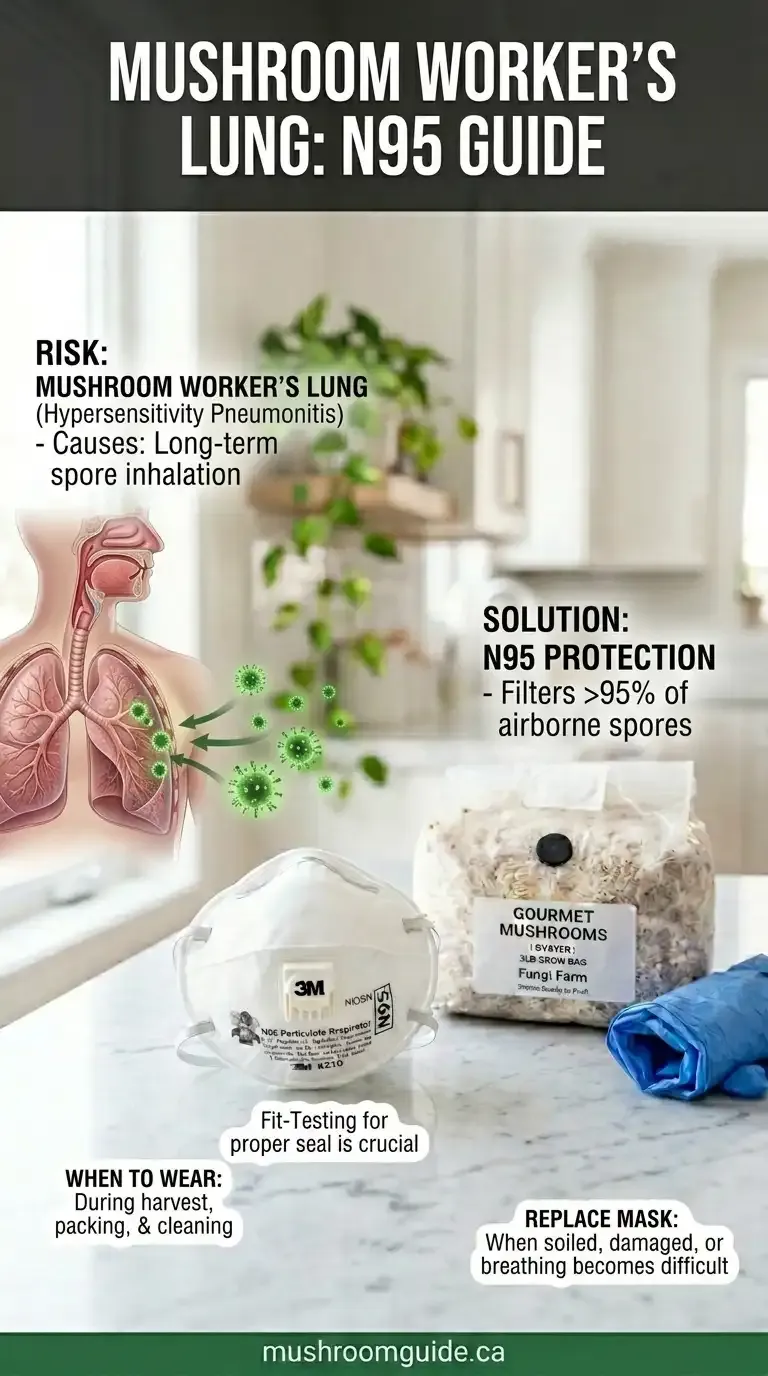
This is a workshop-safety post, not a health post. Spore exposure during mushroom cultivation is an occupational hazard with a specific mechanism, specific prevention, and a specific name: mushroom worker’s lung — clinically, hypersensitivity pneumonitis.
Every cultivation guide on this site links here for the safety reminder. If you grow mushrooms, especially repeatedly, read this once and build the habits early. The cost is a $25 box of N95 masks and 30 seconds of thought per harvest. The cost of not doing it is real and documented.
TL;DR
- What it is: an immune-mediated lung inflammation triggered by repeatedly inhaling mushroom spores
- Who gets it: anyone with enough cumulative exposure — commercial workers most often, but documented in hobby growers too
- Symptoms: shortness of breath, dry cough, fatigue, low fever hours after exposure
- Prevention: N95 mask during spawn handling, harvesting, and fruiting-chamber work + ventilated workspace + exhaust the chamber’s air outside, not back into the room
- Reversibility: caught early and exposure stopped, fully reversible. Chronic exposure → permanent lung scarring.
Educational and safety information only. This is not medical advice. If you have respiratory symptoms after mushroom work, see your doctor. Mention the exposure explicitly — hypersensitivity pneumonitis is commonly misdiagnosed as flu, asthma, or COVID-19.
Affiliate disclosure: Some links below are affiliate links — we may earn a small commission on qualifying purchases at no additional cost to you. See our full affiliate disclosure.
The mechanism (the short version)
Mushroom spores are tiny — typically 5–15 microns. That’s large enough to be filtered by a properly-fitted N95 mask, but small enough to reach the deep lung when inhaled. Once there, the immune system can become sensitized to the spore proteins. With repeated exposure, the immune response intensifies until inflammation in the small airways and air sacs becomes the dominant problem.
The clinical name is hypersensitivity pneumonitis (HP) — sometimes specifically mushroom worker’s lung when the trigger is mushroom spores or substrate dust. It’s well-documented in published occupational health literature; references at the end of this post.
Why oyster and lion’s mane growers are at higher risk
Spore production varies dramatically by species. Per fruiting body, heavy sporulators include:
- Pink oyster (heaviest)
- Blue oyster
- White oyster
- Grey oyster
Moderate:
- Shiitake
- Chestnut mushrooms
Lighter:
- Lion’s mane
- King oyster
Pink and blue oyster are particularly notable because a single healthy fruiting block can release millions of spores per day during its harvest window. If you grow these and harvest unmasked, exposure adds up fast.
What it feels like
Hypersensitivity pneumonitis presents in three forms — acute, subacute, and chronic.
Acute (4–12 hours after exposure)
- Dry cough
- Chest tightness
- Shortness of breath, especially climbing stairs
- Low-grade fever
- Body aches and fatigue
- Headache
People often think this is a cold, the flu, or COVID. The distinguishing feature is timing: symptoms appear 4–12 hours after the exposure (not days like an infection), and they tend to recur on exposure days while improving on non-exposure days.
Subacute (weeks to months)
- Persistent dry cough
- Gradually worsening shortness of breath
- Weight loss
- Loss of energy
This stage is often missed because the symptoms creep in slowly.
Chronic (months to years of exposure)
- Permanent lung scarring (pulmonary fibrosis)
- Reduced lung capacity that doesn’t recover
Caught at the acute or subacute stage and exposure stopped, lung function fully recovers. Caught at chronic, damage is permanent.
The prevention routine (3 minutes per session)
Real, practical, what actually works for hobby cultivation:
1. Wear a fitted N95 mask
Specifically:
- N95 rated (NIOSH-approved). Not a surgical mask, not a cloth mask.
- Fitted to your face. A loose-fitting mask leaks around the edges — defeating the entire point. If the mask doesn’t squeeze gently against your cheeks and nose, get a different size or shape.
- Replace regularly. A single N95 can be worn across multiple sessions if it’s not visibly soiled and still fits. Discard after about 8 hours of cumulative use or if straps stretch out.
A 20-pack of NIOSH-approved N95s from Amazon.ca runs $20–35. Get a pack with your first spawn order. Don’t postpone this.
2. Ventilate the work space
- Open a window during inoculation, harvest, and bag-cutting.
- Don’t work in bedrooms. You spend hours sleeping in them; cumulative exposure from settled spores adds up.
- Don’t work in unventilated basements. If you have to use one, run a box fan exhausting outward through a window.
3. Exhaust the fruiting chamber outside
If you’ve built a Martha tent or any active-FAE fruiting chamber, the exhaust ducting should go:
- Outside through a window or vent, OR
- Through a HEPA filter before recirculating
What you don’t want: a fan blowing spore-laden chamber air directly into your kitchen. See our DIY fruiting chamber build for setup details.
4. Harvest at the right time
Mushrooms release spores most heavily after they reach maturity. If you harvest before sporulation begins, you reduce ambient spore load in your home dramatically.
Use our variety-specific harvest guides: blue oyster, pink oyster, white oyster, king oyster.
5. Clean spore deposits
After harvest, wipe down the fruiting chamber walls and the surrounding surface area. A damp paper towel picks up settled spores; a dry one just resuspends them in the air. Bag the used paper towels.
6. Skip the casual visitors
If a friend wants to “see the mushrooms,” don’t open the fruiting chamber for them. Take a picture instead. Their lungs aren’t your problem, but the spore release into your home is.
What about respirators stronger than N95?
For hobby cultivation at the scale this site covers (1–4 blocks at a time), N95 is the right protection level. Stronger respirators (elastomeric P100, PAPRs) are for commercial workers exposed for 8-hour shifts, multiple times per week, year-round.
If you’re growing at that scale, you’re running a commercial operation and you should talk to your provincial occupational health office, not read a hobby guide.
What N95 masks to actually buy
Generic guidance — not specific endorsements:
- NIOSH-approved. The mask packaging will say “N95” with the NIOSH seal of approval. Avoid masks that say “KN95” without NIOSH approval — they’re a different standard, often poorly tested.
- Cup or folded shape — molded to the face. Avoid “ear-loop only” designs; head straps fit much better.
- Comes in multiple sizes if possible. A box of 20 of one size often includes one or two that don’t fit you well — that’s normal.
- Amazon.ca has the standard 3M 8210, 3M VFlex, Honeywell DC365, and various Canadian-made NIOSH-approved options. Any of these are fine for hobby use.
What if I think I already have symptoms?
If you’ve been growing mushrooms regularly and you have:
- A dry cough that gets worse on harvest days
- Shortness of breath you didn’t have a year ago
- Recurring “flu-like” symptoms that don’t match anyone else’s flu
- Unexplained fatigue around your growing activity
See your doctor and mention the exposure. Bring a list of species you grow, the frequency of your sessions, and whether you’ve worn a mask. Hypersensitivity pneumonitis is commonly misdiagnosed when the exposure history isn’t volunteered.
You’ll likely get:
- Chest imaging (X-ray or CT scan)
- Pulmonary function tests
- Sometimes a blood test for antibodies to mushroom spore proteins
The treatment, in early/subacute stages, is stopping the exposure — either temporarily (until lung function recovers) or permanently (switching to a different hobby).
Bottom line
Hypersensitivity pneumonitis is the single most common cultivation injury you’ll never read about in a “how to grow mushrooms” YouTube video. It’s well-documented, completely preventable, and the prevention is cheap.
- N95 mask: $1–2 per harvest
- Ventilation: free
- Discipline: 30 seconds of putting the mask on before you open the bag
This is the boring safety post you read once and then follow forever.
References
For those who want to read the actual research:
- Bunger J et al. Cytotoxic and allergenic potential of bioaerosols from a recyclables sorting plant. Annals of Agricultural and Environmental Medicine, 2007.
- Sakula A. Mushroom-worker’s lung. British Medical Journal, 1967.
- Cox J et al. Hypersensitivity pneumonitis in mushroom workers. American Journal of Industrial Medicine, 1988.
- Mariné Plana A et al. Hypersensitivity pneumonitis in mushroom workers. Allergy, 2003.
PubMed search: “mushroom worker’s lung” or “hypersensitivity pneumonitis mushroom” returns hundreds of relevant studies.
Related cultivation safety reminders run at the end of every grow guide on this site: How to grow oyster mushrooms in Canada, How to grow lion’s mane mushrooms in Canada, How to grow shiitake mushrooms in Canada, DIY fruiting chamber build.