How to grow chestnut mushrooms in Canada
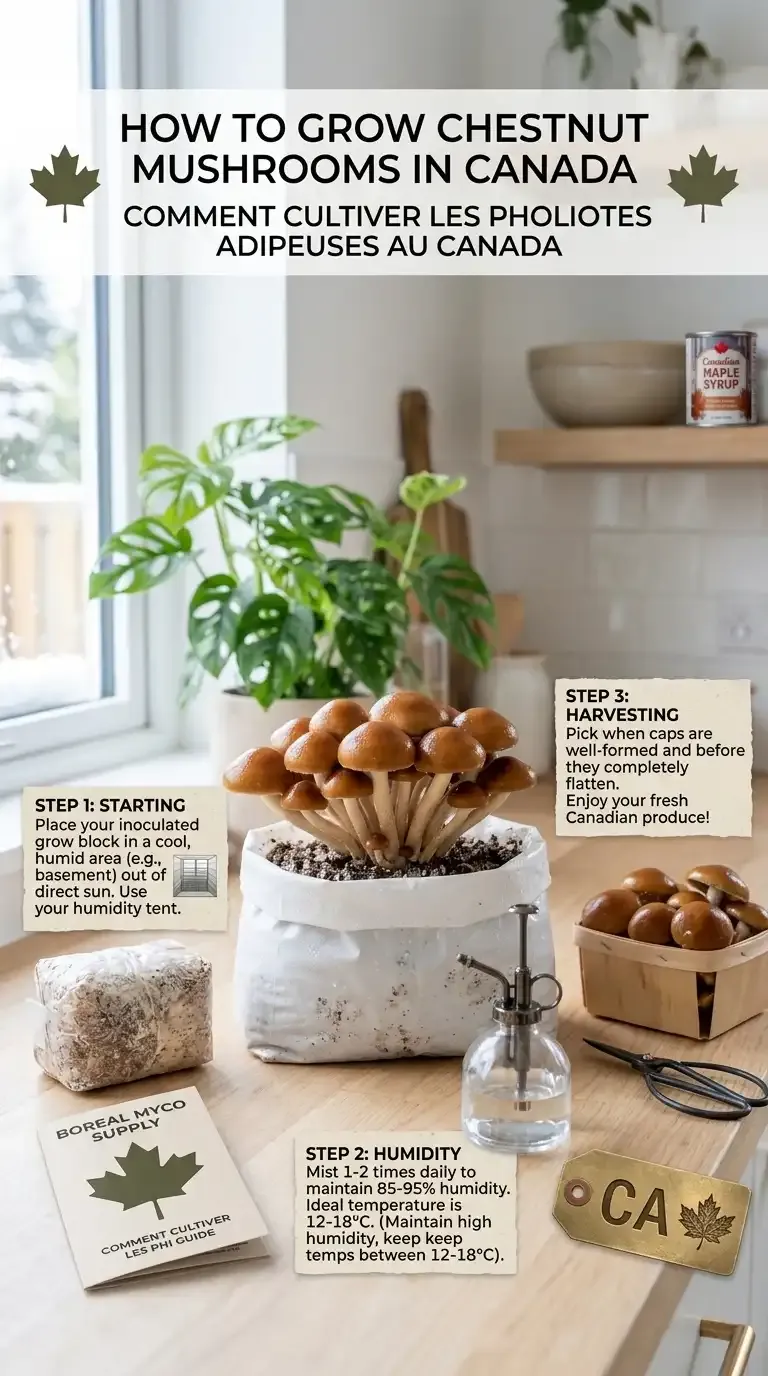
Chestnut mushrooms (Pholiota adiposa) are the species nobody at the grocery store has heard of and everybody who grows them recommends. Caramel-brown, slightly sticky on the cap, dense and crunchy through — they’re one of the rare cultivated species where the texture is the headline.
This guide is how to grow them at home in Canada. If you’re new to mushroom cultivation entirely, read how to grow oyster mushrooms in Canada first — chestnuts use the same pressure-sterilization technique as lion’s mane and shiitake, which is one step harder than oyster.
TL;DR
- Substrate: supplemented hardwood sawdust (80/18/2 hardwood / wheat bran / gypsum)
- Sterilization: required — 15 PSI for 2.5 hours
- Spawn: 5–10% by weight
- Colonization: 14–21 days at 22–25 °C
- Fruiting: 15–22 °C, 85–95% humidity, 6 ACH FAE
- First harvest: 4–6 weeks after inoculation
- Yield: 1.5–2.5 lb (700–1100 g) fresh per 5 lb block, across two flushes
- The wild card: clusters are denser than oyster — get the FAE right or you’ll get small malformed bouquets
Why chestnut mushrooms
Three reasons to grow them:
- They aren’t sold fresh in Canada outside a handful of farmers’ markets and specialty Asian grocers. If you want fresh chestnuts, you have to grow them.
- They hold their crunch better than any other cultivated species — through stir-frying, pickling, freezing, even drying-and-rehydrating. This is a textural ingredient.
- They’re more forgiving than lion’s mane and shiitake despite needing pressure sterilization. The cluster shape is dramatic, the yield is decent, the cycle is short.
Reasons to skip them:
- You don’t have a pressure cooker. Oyster on straw is still the right first species. See our best pressure cooker for mushroom growing in Canada when you’re ready to upgrade.
- You want shelf appeal — chestnuts are gorgeous on the block but less photogenic than the cascading white of lion’s mane or the magenta of pink oyster.
Substrate recipe
Standard supplemented hardwood sawdust:
- 80% fine hardwood sawdust (oak, maple, beech — not conifer, not walnut)
- 18% wheat bran
- 2% gypsum (calcium sulfate)
- Hydrated to 60% moisture (squeezes 1–2 drops at field capacity)
Use our substrate calculator for sizing.
A 5 lb (2.3 kg) hydrated block typically needs:
- 730 g hardwood pellets (which expand to ~2 kg hydrated sawdust)
- 165 g wheat bran
- 20 g gypsum
- ~1.3 L water
Pellets are the cheapest hardwood source in Canada — get them from a feed store or a hardware store that sells fuel pellets. Wheat bran from a feed/bulk-food store. Gypsum from a garden centre.
Sterilization, not pasteurization
Chestnut mushrooms on supplemented substrate must be pressure sterilized:
- 15 PSI for 2.5 hours
- 8–12 hour natural cool-down (don’t vent manually)
Pasteurization is not enough. The 18% wheat bran is nitrogen-rich and will be overrun by Trichoderma within days if you skip the pressure cooker.
Spawn
- Grain spawn (millet, wheat, rye) in a filter-patch bag — the most common option
- 5–10% by weight of finished substrate
- Order from a Canadian supplier (Sporeworx, MycoSupply, North Spore ships from US) — chestnut spawn is sometimes intermittent stock, so pre-order a couple of weeks ahead
Inoculation
In a still-air box:
- Wear an N95.
- Open the cooled, sterilized bag.
- Crumble 150–230 g of chestnut grain spawn evenly through the substrate.
- Seal the bag with a heat sealer (or fold-and-tape if you don’t have one).
- Mix by shaking and squeezing — distribute spawn uniformly.
Colonization (14–21 days)
- Temperature: 22–25 °C — warmer than oyster, in the same range as lion’s mane and shiitake
- Light: dark
- What you’ll see: white mycelium spreads from each spawn point; by week 2 most of the substrate is white; by day 18–21 fully colonized
- Yellow exudate is normal. Pholiota species exude a small amount of yellow liquid during late colonization. As long as the substrate smells mushroomy (not sour or ammoniac), it’s healthy.
Contamination signs:
- Bright green = Trichoderma — toss the bag
- Black or pink = bacterial — toss
- Yellow staining without slime = normal Pholiota expression
- Faint nutty / sweet smell = healthy
See common mushroom contamination for the full troubleshooting reference.
Fruiting
The chestnut sweet spot is closer to lion’s mane than to shiitake.
- Temperature: 15–22 °C (cooler = denser, more pigmented clusters)
- Humidity: 85–95% RH
- FAE: 6 air changes per hour — chestnut is between oyster (4 ACH) and lion’s mane (8 ACH) for CO₂ sensitivity
- Light: 12 hours/day of indirect light
- Pinning trigger: if no pins by day 7 of fruiting conditions, drop the temperature 5 °C for 48 hours
Cutting fruiting sites
Once the block is fully colonized:
- Cut two X-shaped 5 cm slits on opposite sides of the bag, roughly 5 cm from the top.
- Place in the fruiting chamber.
- Mist the slits 1–2× daily.
Pins emerge from the slits within 5–10 days as dark brown bumps. Clusters mature over the following 5–7 days.
Harvest
Chestnut mushrooms are ready when:
- Caps are fully expanded (not still curled under) but before they flatten and the gills are exposed underneath
- Cap surface is glossy mahogany-brown — not faded to pale buff
- No visible sporulation on lower caps or surrounding substrate
To harvest: twist each cluster off at the base. Don’t cut — twisting leaves a cleaner wound that the block can re-fruit from for the second flush.
Typical first-flush yield from a 5 lb block: 1.0–1.5 lb (450–700 g) fresh. Second flush, 10–14 days after the first soak, adds another 0.5–1.0 lb. Use our yield estimator for your specific setup.
Between flushes
After the first harvest:
- Submerge the block in cold water for 8 hours. Less than for oyster (12 hours) because chestnut blocks are denser and over-soaking can promote contamination.
- Drain.
- Return to fruiting conditions.
- Pins reappear within 7–10 days.
A third flush is possible but usually small. Most growers compost the substrate after flush 2.
Yield reality check
Chestnut sits between oyster (high yield, low value) and lion’s mane (lower yield, higher value):
- Biological efficiency: ~40% first flush + ~18% second = 58% over two flushes
- 5 lb block → ~1.5–2.0 lb fresh
- Per-mushroom value: ~$20–30 per lb at Canadian farmers’ markets when available — but they almost never are
The value of growing your own chestnut isn’t in saving money over grocery prices; it’s in having access to a species that you literally cannot buy.
Canadian regional notes
BC south coast
Year-round growing. The mild, humid climate suits chestnut better than most provinces.
Prairies
Dry winter air is a bigger challenge for chestnut than for oyster — the denser fruit-block structure dries out faster. Use a small humidifier in the fruiting chamber.
Ontario / Quebec
The default Canadian growing climate. Indoor cultivation works year-round; outdoor wood-log inoculation is also possible (see outdoor log inoculation).
Atlantic Canada
Humid summers favour chestnut cultivation. Watch the fruiting chamber for excess moisture during damp stretches.
Far north
Possible but slow. Use the warm end of colonization range (25 °C) and consider supplementary heat on the fruiting chamber.
In the kitchen
The point of chestnut mushrooms is the crunch. Cook accordingly:
- Stir-fry: high heat, 4–5 minutes, salt at the end
- Pickled: 5-minute simmer in rice vinegar + water + sugar + salt; pack in jars with aromatics; refrigerate
- Roasted as side dish: olive oil + salt, 425 °F (220 °C) for 20 minutes
- Don’t slice thin — you lose the textural point
- Don’t braise long — they get tough, not tender
See our chestnut mushrooms post for more on flavour, pairings, and why interest in this species is up 450% in Canadian searches.
Spore safety
Wear an N95 mask when handling spawn, opening colonized bags, cutting fruiting sites, and harvesting. Pholiota species are moderate sporulators — lower than oyster, higher than lion’s mane.
Common failure modes
| Symptom | Cause | Fix |
|---|---|---|
| No pins after 10 days at fruiting conditions | Substrate too cold OR not fully colonized OR CO₂ too high | Wait longer; drop temp 5 °C briefly; increase FAE |
| Clusters small and stringy | FAE too low | More ventilation |
| Yellow liquid pooling | Normal Pholiota exudate, not contamination | Wipe off; continue |
| Green patches on substrate | Trichoderma contamination | Toss; better sterile work |
| Caps fully flat with visible gills | Past prime — harvested late | Pick earlier next time |
| Second flush is much smaller | Normal — chestnut second flushes are 30–40% of first | Expected; compost after flush 2 |
Related: Chestnut mushrooms — why interest is exploding — the cooking + market context for this species. How to grow lion’s mane mushrooms in Canada — uses the same pressure-sterilization method. Best pressure cooker for mushroom growing in Canada — what you need for supplemented substrates. Substrate calculator, fruiting chamber calculator, yield estimator.
Safety & data: Mushroom worker’s lung: N95 spore-safety guide — the spore safety every grower needs. Mushroom growing conditions chart — temperature, humidity & timing for every species.